The Hunt Brothers were traveling guards who formed a trade company that specializes in large caravans that are heavily guarded. On high risk targets, the brothers are still willing to travel themselves with the caravan.
Archives
Iaross
Iaross is a Uthgardian woman who joined the Wanderers just four years ago. She had been a mage in the Ministry who was shipped off to fight in the recent Giant Wars. She was crippled by a boulder which crushed her legs and her spine. She was able to heal herself enough to stave off death, but her spine did not heal correctly, leaving her unable to walk.
She lives with Gylas, her library taking up about as much as his alchemy tables in the Cauldron shop in Elmhearth. She is always excited to help those who are out adventuring, lending her extensive knowledge and tomes to those who seek her help.
Spells Known:
- Aid
- Bear’s Strength
- Conjure Elemental
- Elemental Arrow
- Elemental Shield
- Heal
- Open
- Orrilot’s Constitution
- Warding Armor
Imp
Imp, Fire
Challenge Rating: 3
Size: Small
Type: Navirite Fey
Initiative: +5
Defense
Hit Points: 13 (3HD)
Armor Class: 16 , touch 12, flat-footed 15 (+1 size, +1 Dex, +4 natural)
Saves: Fort +3, Ref +4, Will +3
Weaknesses: Magic or legacy weapons, cold
Offense
Speed: 30’, fly 50’
Base Attack: +3
Melee: 2 claws +4 melee (1d3 plus 1d4 fire)
Ranged: –
Special Attacks: Breath weapon, spell-like abilities
Sanity Effects: First Encounter 1/1d4
Statistics
Abilities: STR 10, DEX 13, CON 10, INT 6, WIS 11, CHA 15
Skills: Acrobatics, Athletics, Awareness, Endurance, Knowledge, Persuasion, Spellcraft, Survival, Thievery
Talents: 2 points or recommended: Dodge, Improved Initiative
Special Qualities: DR 5/magic or legacy, dark vision 60’, immune to fire, fast healing 2, cold does double damage
Ecology
Environment: Any
Organization: Any
Treasure: Standard
Breath Weapon
15-foot cone, damage 1d8 fire, Reflex half DC 12.
Spell-Like Abilities
1/hour—mage fire (DC 14); 1/day—heat metal (DC 15)
Fast Healing
A fire imp heals only if it is touching a flame at least as large as a torch.
Iron
Iron and Steel
Iron and steel are quite common in Atheles. Iron and Steel are both used to ward against magic.
Iron and steel cause damage to magic users and magic creatures in Atheles.
If casting magic, these metals cause these effects:
Iron – On skin 1d6 per mana, in skin 2d6 per mana, on body, but covered (wrapped, leather bound, etc) – slight irritation.
Steel – On skin 1d3 per mana, in skin 1d6 per mana. On body, but covered (wrapped, leather bound, etc_ – no effect.
Iron – On skin 1d4 damage per hour, in skin 2d4 per hour, on body, but covered (wrapped, leather bound, etc) – slight irritation.
Steel – On skin 1d2 damage per hour, in skin 1d4 per hour, on body, but covered (wrapped, leather bound, etc) – no effect.
Iron – On skin slight discomfort, in skin moderate discomfort, on body, but covered (wrapped, leather bound, etc) – slight irritation.
Steel -No effect.
Feral Elfling:
Iron – On skin 1d4 damage per hour, in skin 2d4 per hour, on body, but covered (wrapped, leather bound, etc) – slight irritation.
Steel – On skin 1d2 damage per hour, in skin 1d4 per hour, on body, but covered (wrapped, leather bound, etc) – no effect.
Iron Golem
Golem, Iron
Challenge Rating: 13
Size: Large
Type: Construct
Initiative: -1
Defense
Hit Points: 129 (18HD)
Armor Class: 30, touch 8, flat-footed 30 (-1 size, -1 Dex, +22 natural)
Saves: Fort +6 Ref +5 Will +6
Weaknesses: Tritium
Offense
Speed: 20ft
Base Attack: +12
Melee: 2 slams +23 melee (2d10+11)
Special Attacks: Breath weapon
Sanity Effects: –
Statistics
Abilities: STR 33, DEX 9, CON –, INT –, WIS 11, CHA 1
Skills: Acrobatics 0, Athletics +21, Awareness +0, Endurance –, Knowledge –, Persuasion –, Spellcraft –, Survival +1, Thievery 0
Talents: —
Special Qualities: Construct traits, damage reduction 15/tritium, darkvision 60 ft., immunity to magic, low-light vision
Ecology
Environment: Any
Organization: Solitary or gang (2-4)
Treasure: None
Combat
Breath Weapon
10-foot cube, cloud of poisonous gas lasting 1 round, free action once every 1d4+1 rounds; initial damage 1d4 Con, secondary damage 3d4 Con, Fortitude DC 19 negates.
Immunity to Magic
An iron golem is immune to any spell or spell-like ability that allows spell resistance. In addition, certain spells and effects function differently against the creature, as noted below.
A magical attack that deals electricity damage slows an iron golem (as the slow spell) for 3 rounds, with no saving throw.
A magical attack that deals fire damage breaks any slow effect on the golem and heals 1 point of damage for each 3 points of damage the attack would otherwise deal. If the amount of healing would cause the golem to exceed its full normal hit points, it gains any excess as temporary hit points. For example, an iron golem hit by a fireball gains back 6 hit points if the damage total is 18 points. An iron golem gets no saving throw against fire effects.
Ish
A large empire nation in the Southwest area of Atheles.
The Empire of Ish has survived for over 1500 years. It was formed by Da’atra Tiria, a powerful warlord who banded all the tribes together. He was from the deep Southern lands of Ish, and he claimed heritage to the gods of the desert. This belief still holds to this day, those of the Tiria family believed to being part gods and those related to him as the trueblooded Ishians.
Da’atra and his chosen, Empress Taraherra, were both gifted in magic, and used the life power of slaves to build and solidify their empire. The Wizards of Ish were formed, their power gifted to them by the gods through Da’atra. With the use of vast armies of slaves, Da’atra and his wizards subjugated the other kingdoms of the south. Through magic Da’atra and his wife lived beyond the normal life of humans, and their many children took over positions of power throughout the Empire. The empire was taken over by their first son, Ka’atra, who continued what his father began, and built the city of Ish, which surrounded a large lake in the middle of the southern desert.
- 4134 TM The Empire of Ish (called the Ishian Empire in the North) is formed in what becomes known as the Southlands. The first emperor of Ish is Da’atra Tiria. The Tiria family still rules in Ish now.
- 4175 Terramahut builds the City of Pathanamitta near what is now the Foothills of Tuk.
- 4356 The City of Pathanamitta is destroyed by the invaders from Ish. The city sinks into the desert, cursed by Taraherra, the wife of the emperor.
- 4362 The City of Raza Buraka is built by the escaped Warlord Tel Amarn. He escaped the destruction of Pathanamitta 6 years before.
- 4383 Tel Amarn dies and his City of Raza Buraka sinks into the desert falling to the curse of Taraherra also. Its Twin city, on the eastern side of the mountains is captured by the Empire and used as a main trade hub.
- 4693 The People’s Uprising. The current emperor is found guilty of heresy by the Priests and exiled. A young priest named Kalah, who has the divine blood from both his mother as a priestess, and his father as a brother to the old emperor, is ascended to the throne.
- 4695 Emperor Kalah bans the use of books. He says the emperors have long filled them with heresy and it is better to start anew. During this time, many of the ancient texts and tomes are burnt. He also empowers the Desert people of the Jal Dur desert, promising them their own nation if they rid the wildelands of the elves. This leads to a genocide of the wild elves and though they finally push back and defeat the desertmen, they are left weakened and forever scarred.
- 4729 (Westlands) The Mages of the West are formed. Ruled by three wizards they congregate in a large keep( Keep of Ismaren in the Misty Moor) along the Western coast ( Above the Vale of current times). Distrusted, they spend most of their time in solitude.
- 4629 The Mages of the West create the Gatestone. Fearing what they have created, they lock it away deep within their keep.
- 4743 Small border skirmishes between the Ishian Empire and the Westlands (Endamas) begin.
- 4745 The Ishian Empire invades North, the priests afraid of the power of the Mages of the West.
- 4757 The Ishian wizards invade the keep of the Mages of the West. Most are killed and many of their books are destroyed. The Gatestone is found and used to transport large groups of the Empire’s armies throughout the Westlands.
- 4759 The Emperor Enockt falls ill and dies, and a plague ravages the Empire. A peace treaty is written between Endamas and Ish.
- 5054 Uthgard begins its war to control Atheles by invading Tiren (The Great War, The Aradan War)
- 5057 Small border skirmishes between the Ishian Empire and Endamas begin again.
- 5059 The Ishian Empire breaks the treaty and begins invading the Westlands.
- 5062 Uthgard attacks Raza Kuraka and takes the city. The Ishian Empire tries to use the Gatestone to retake the city, but instead, they lose the Stone to Uthgard.
- 5073 The Ishian Empire, worn down by years of war, pulls their troops back and fortifies their borders. The elves stop their war, the high elves retreat into their forest and some of the grey elves and wood elves that are left lend their aid to Seladar (capital of the Aradan Kingdom).
- 5082 Seladar is destroyed. The city is evacuated. Aeerumar Aradan, last king of Selador is slain by one of his advisors, Caroth. Uthgard uses the Gatestone to open a rift from the battlefield into the heart of the city, ensuring victory.
- 5132 Second invasion of the West by Uthgard. Seahaven and Bordon, with the help of the Ishian Empire, push back the forces of Uthgard. Uthgard uses devastating magic again, ruining more of the Eastlands. In a massive final battle, Uthgard is defeated and the Warlock King is slain. During the culmination of the battle, the Disappearance happens.
- 5133 Ish is hit hard for decades by the magical storms that come over the mountains from the ruined wastelands of Aradan. Without the power of the Priesthood, the Empire starts to crumble.
- 5677 The first recorded instances of the Return.
- 5683 The Dark Return. Magic flows through the lands.
- 5690 The Ishian Empire opens its borders and allows small bits of traffic. Much of the knowledge of the past is lost, the West and Northlands are no longer under the control of a single king, but instead separate entities. Bordon is still looked upon as protector of the Westlands and an uneasy peace settles over the land.
- 5698 South Keep, once a single fortress outpost along the Ishian border, starts to become a well-known trade town.
Wizards of Ish
The Wizards of Ish keep their secrets close. Once trained they are never allowed to leave the ranks of the Sorcerers. Of all the magic groups, theirs was the most untouched during the Disappearance and their stronghold in the center of Ish remains as it has for over a thousand years. But whatever knowledge they may have, they keep to themselves.
Much like the rest of the Ishian Empire their policies are strict, and death or slavery is a just punishment.
One of the biggest differences between the Wizards of Ish and the majority of other magic using groups, is their use of slaves as power reservoirs for magic. Powerful wizards can have a stable of slaves, blank eyed and pale, who are kept on leashes as a source of power for their magic.
Ansely, Mage of Eredar, Eastlands
From the Encyclopedia Atheles
“We are all but servants.”
Ishian wizards view themselves as conduits of God, and therefore as priests instead of workers of arcane magics. The wizards of Ish call themselves the Najur, an ancient word for servant. They, like most in the Ishian Empire, worship Tanthu-Ra, a sun deity. This is why all in the priesthood wear yellow robes.
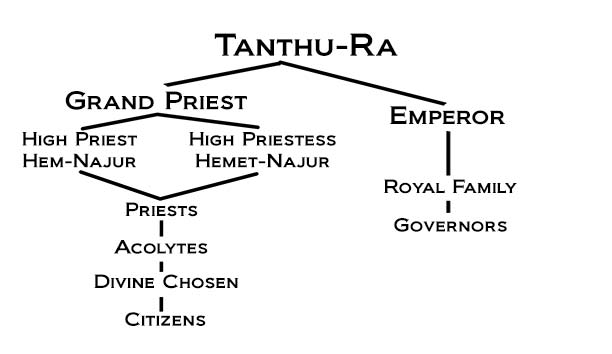
They are ranked very high within the culture of Ish, with the Grand Priest even being considered higher than the Emperor.
They occupy the Temple of the Sun, a large squat building made of black stone.
They take volunteers from the citizenry to give themselves to God. This means that they willingly become vessels for the wizards to take energy from for spell casting. The Najur see them as disciples, who become vessels to the all power of Thanthu-Ra.
Religious Foundations
In the beginning, there was void and light. When light pulled free of the void, it became Rau, the creator, and the void became Vau, the destroyer. The space between Rau and Vau became Tau, the ocean. Rau and Tau moved away from Vau and when they did, Uau, the earth, was formed. With these three elements, all sorts of life sprang forth, including the holy ones. These were god like beings that helped form what life was on Uau. For long eons, the world grew and flourished. One of the holy ones, Orset, was jealous of other life and set to make himself more powerful by aligning with Vau, which introduced death. But death was not just for the other animals, and now the holy ones, too, knew time and death. As they died, their spirits fell upon the earth, and the terans of the lands who worshipped them inherited their spirits. The more holy spirit they inherited, the more revered they were. This led to wars between the holiest. And there were many tribes fighting. One tribe was led by the powerful lord Da’atra.
It was on his 25th birthday when the great comet came down from the sky. In the crater, there was a man who was found. This was Dhuoth, who claimed to be the child of Tanthu and Ra. This tall being looked different than other Ishians; he was taller and paler of skin. He provided Da’atra with great wisdom and helped him conquer his foes. He also preached to the tribe of the great power of Thanthu the Sun god joining with Rau the creator, marking them as a direct line to Creation itself.
Dhuoth would become the first Grand Priest when Da’atra became the first emperor. Dhuoth would help the Ishian empire grow, and he lived for hundreds of years. No record of death is ever found for Dhuoth, though many historians speculate that he was killed during the usurpation of Ish by Kalah.
The Rebellion – Mages who fight against the tyranny of the Empire and the Wizards of Ish
The Rebellion is a rather new group of mages who oppose the rule of the Emperor and the Wizards of Ish. They are hunted mercilessly throughout the Empire, but as magic has reawakened, they have grown in numbers and in power.
Secret is their strongest advantage, so very little is known of them.
Jan Melgrin
Merchant trader. Many different items importing and exporting.
Small business, but has ties with the Wanderers.
Jarin Plainswalker
As one of the chief chroniclers in the Druidic Conclave of Culture and Antiquity, I’ve gained a broad view of the world and its cultures – not only as it exists today, but as it has existed through the Ages. Yet, despite my learning, there is but one fact that I can say here with certainty – that the only constant in this world is change and uncertainty. This change occurs in all aspects of life and the environments in which life resides . . . and this is the great challenge of the historian. Climates, flora, fauna, populations, cultures, the stars, civilizations, the seasons, and even consciousness – all of these exist in a state of continuous flux. Some change is cyclical; some is so slow that it is imperceptible; some is predictable while some is not. Some change occurs so rapidly that the lives affected have no time to prepare. And in many cases, no record is left of this change other than nebulous clues from which we can infer the past with varying degrees of accuracy. Sometimes it’s merely a few scattered bones, turned to stone over the millennia. Often we’ve found entire cities buried beneath the earth, found evidence of cultures lost long ago to the sea, or newer civilizations merely left in ruin by inhabitants who either migrated, fled, or perished.
Long ago, the Druids had vast libraries of historical books and tomes, chronicling ages past, but during the Great War these depositories of knowledge were lost or destroyed. Before our small circle of historians began compiling historical records, evidence, and accounts into a new central library, people throughout the world knew little more than the sliver of knowledge available to one’s own culture – usually passed down orally through generations. Today, this is still the case for most. I find that if I talk to three different people from three distinct cultures, I feel as though I’m hearing of three different worlds altogether, with very little thread to pull them together beyond the same passing of celestial bodies overhead – even even in that regard, interpretations vary. We all agree there is a sun that rises on one horizon and falls beyond the other, but I’ve found very little agreement on the nature of the sun. And those interpretations of basic nature have changed even within cultures with the passage of time.
The desert people of Jaldur once believed, according to their elders, that the sun was merely a tear in the veil of darkness, and that if one could get beyond the veil, all would be ablaze. In other words, we are protected by a perpetually rotating cocoon which protects us from the infinite fire beyond. The hole, they believed, was like the beginning of a bird hatching from an egg, and eventually the world itself would be born into a world of infinite light. There were even very precise predictions. When these predictions failed to become reality, the sun’s nature evolved. Noting the arc that a thrown object takes as it ascends into the sky and then descends back to the earth, they realized that the sun’s movement is very similar – as if someone were throwing an enormous flaming ball into the sky from one direction, and it was falling in the other direction. So now they’ve come to believe in giant deities, large enough to throw this flaming ball. Within this single culture, there is disagreement about whether the thrower is benevolent, playful, or at war.
This is the greatest challenge of the historian. It would be tempting to merely compile all that we are told into the annals, but we must take into account the unique perspective of the storyteller. We must consider that time changes stories, and after generations, the stories may bear no resemblance to the reality of the past. The story belongs more to the teller than to reality itself. The story becomes infused with the teller’s own ambitions, imaginations, prejudices, preconceptions, misconceptions, mythologies, fears, hopes, and dreams.
And this is equally true of my own telling, here. As I recount my tale of Elvish encounters, I will be honest and forthcoming. And yet, despite my best efforts, this work will certainly remain imperfect – colored by my own narrative, and limited by my own narrow perspective, and my own prejudices. Forgive me if I seem to have a particular fondness for the elves of the woods, as they treated me with utter kindness. Equally, forgive me if I fail to hide my personal distrust of Oredhel, as they spared no affection for me or my kind, and demonstrated ghastly and unjust brutality before my eyes, laughing as I wept. I know the reasons for the sharp edge to their culture, and yet I cannot possibly entirely hide my contempt.
And with that, I shall begin my tale.
There are many myths about the elves of the western lands, and in my travels I have collected much of their history and culture. Given the great mystery surrounding the elves, and the fact they had not been seen by any credible source in generations, I most wanted to see their perspective. How do they seem themselves? How do they believe they fit within the massive social constructs of Uteria? What is their place, and what could be their place in the future, so that we might all coexist in relative peace?
This has been difficult. Most, myself included, have been taught fables of elves rather than honest history. These fables are often of a god-like race, with impossible virtues. Other times, the fables take a much darker tone, designed to scare children into following directions, lest an evil elf kidnap them and cook them into a stew. The one thing I’ve never found in these fables, however, is accuracy. We have only just begun to learn the truth of the elves as they once again began to emerge from their forests and plans, becoming once again a part of human culture.
So hopefully these stories, myths, and histories of the elves will help us to gain some insight into one of the most secretive and powerful races in Uteria.
Jarin
5704 Common Era
Jarin Plainswalker – NPC Guide
Jarin Plainswalker is a druid who wanders the lands collecting knowledge and artifacts of the fey races. He is a human from the city of Bordon, though after joining the Druid Council he has spent much of his time on the road. His spheres of magic specialize in healing and earth elements, and his knowledge focus is that of the ancient fey races.
He can be used as a loremaster in your campaign, or a companion for your players to fill in a healer role. His knowledge of ancient races surpasses many, and he is valuable in identifying old items, or deciphering ancient scripts.
Introducing Jarin into your Campaign
Jain plays a large part in the world of Uteria. He is the current chronicler of the Elves and has left the Council in Bordon to travel the roads for seven years while he researches the current cultures of the elves.
In your campaign he can be found anywhere, from a city tavern to a camp along a remote river. His specialty is the fey, and his studies will allow him to help the players if they need lore of the elves.
Jarin is very charismatic and when he passes through he often makes many friends with his animated stories and jokes. He has built a wide network of friends who are willing to help Jarin or anyone named his friend. If Jarin has a flaw it is also in his stories, in that his love for getting all the facts correct can lead to some feeling he is a little long winded when a short answer might be preferred.
Beginnings
Origins of Jarin – From the files of the Druidic Library of Seahaven
Letter from the Druid Council of the West to ArchDruid Erlwyn, of the Grand Council of the North
5707 Fourth Age
In Regards to the newly formed Conclave of Culture and Antiquity,
I am writing to ask that we assign Jarin Plainswalker as the fifth and final member of the Conclave. I have done much thinking on who would complete the group and add different perspectives to our goals. Jarin is a unique individual among the Druids and one of the first of the next generation who will lead the Council into the future. I will provide a brief description of his person and upbringing to illustrate my desire to have him in the Conclave.
He was born near Bordon among the small farms in the plains to the west of the Swordspyne Mountains. When he was the age of 13, a goat on his farm was severely injured and his parents found him nursing the small animal and crying. When they tried to take the animal away for slaughter, he screamed out and as his parent described it a blue light shot forth from their son into the animal. When they regained their sight, the animal’s leg, which had almost been torn from its socket by a wolf, was completely healed. Luckily for young Jarin his parents were not as superstitious as most and they contacted us about their son. We here in Bordon were fascinated to find such a young person possessing the innate ability to heal. He was brought to the Grove here and started his tutelage immediately.
Though he showed immense talent, he was also very headstrong and often was found exploring the mountains and wilderness around Bordon rather than attending to his studies. After he graduated from apprenticeship, he immediately took to the field studying the Westlands for ancient sources of magic. This made him rather unpopular among the Arch Council here, though his devotion to finding out about the past drove him to continue. During his middle twenties, he spent much of his time near the Town of Byrn, exploring deep into the swamps to the West of Kaelnor forest, looking for the “Keep of the Mages”, which according to most myths existed there in the past Age. With Byrn’s relative proximity to the Vale, Jarin became very fond of the Elflings, which lead to his many inquiries up North to you of past writings about the other races of Uteria. Since the Elflings are one of the few others races to have open and friendly contact with humans since the last Age, Jarin hoped to find a way to open relationships with the other races. He was especially interested in the Elves, seeing their connection to magic and the past Age.
I hope to assign him to look deeper into the stories behind the elves and bring us more concrete knowledge of who they are and what they have been doing since they shut themselves away in the different corners of Uteria.
Even the formation of this Conclave has been difficult due to the Arch Druid Council here, and adding an outsider to what they consider a dangerous avenue of research, has led me to a dead end.
If you were to send word to the Council here, it would go a long way in allowing me to form the Conclave as would best suit its needs, rather than the Arch Council’s needs.
May Arias Bless you,
Irphazan
A Brief History of Jarin
Jarin spent his childhood as the middle child on a farm, uneventful until his bond to magic was revealed. Once accepted into the Druidic Order he spent his adolescence studying in Bordon. He was a difficult student, often spending more time outside the city walls exploring than with his books. As his teachers learned about his personality and adjusted his studies to be less academic and more hands on, he excelled in classes and was sent into the field as an apprentice to Master Ensin. Ensin was a druid who shared Jarin’s wanderlust and together they spent a few years exploring the dangerous swamps in the west. After Ensin’s untimely death to a Unman’s arrow, he was admitted to a special group who were to try and unlock the mysteries of the last age.
Though many welcome Jarin when he is around, he has no true home. All he owns he carries with him, though he often leaves copies of his journals and sketches in various hiding places along the road.
Description
Jarin is a thin man, slightly shorter than normal, though fast and quick witted. He has a contagious smile, and his eyes have had laugh lines since he was a young adult. He is just as quick to tell a story as he is to sit and listen for hours. He has little use for expensive belongings, but he loves well crafted and artistically intricate items. One belonging he holds dear is a bone handled dagger given to him by his old Master, Ensin.
Becoming Friends with Jarin
It is quite easy to win over Jarin, though to really gain anything besides surface information, Jarin must trust the players not to misuse the information.
Encounter with Jarin
Willow Tree Inn – Byrn
Jarin is sitting by the fireplace telling a story of the swamps to the northwest. His has a small gathering of patrons listening intently.
“The mud seeped into our boots, and pulled at them as we stepped. Bloodflies swarmed around us, their incessant buzzing making this miserable place even worse. But somewhere out here, somewhere there is the Keep of the Magi.
Kaelvari
The Kaelvari, the Forest Elves
The Kaelvarian Elves are the basis for much of the lore that humans cling to about the elves of Uteria. They are tall and exude strength, but dislike confrontation and aggression. They live deep in the woods, a solitary culture that is self-sufficient and peaceful. They revere nature, and despite my initial impressions of power, they believe deeply in being in harmony with the world around them rather than its masters. Music and art are very important to the Kaelvari and this is reflected in all facets of their culture.
They have lived in the same part of Uteria for centuries, their settlements based around the deepest regions of the Kaelnor forest, in groves of the largest Ergan trees. Very few outsiders over the long years have been allowed to visit these hidden cities.
The Lands of the Kaelvari
The Kaelvari elves live in the center of the Westlands, residing in the dense Kaelnor forest, south of Ferryport. There are many superstitions and stories about the forest, with only two paths that travelers frequent to head south. One runs through the center of the forest, following a valley which is bare of trees and foliage. I, myself, had traveled the forest extensively looking to contact the elves. This was before the liberation of Ferryport and the Kaelvari had not yet emerged from the forests to make contact with our kind. The locals claimed that the eastern part of the forest was the residence of the elves, while the western part, which turns to swamplands, was inhabited by twisted monsters.
Kaldrath
Kaldrath was an eldar who lead a genocide against his own people for their abuse of the peoples of Uteria.
The Story of Kaldrath
Kalrath’s father, Jariaan, was of high birth in the ranks of the eldar. He did not believe if the eldar’s practices of keeping the elves as slaves and servants. Later in his life he fought the rulers of the eldar to free the elves and to consider them as equals. The eldar kicked him from their society. The eldar felt they were doing him a great justice by not outright killing him. He sought refuge among the elves and their independant smaller city, but he was stoned and ran out of the city. There he died alone in the wilderness, forsaken by his race and those he tried to help. Kaldrath never forgot this. His hatred of of the eldar grew until he left to form his armies to destroy them all. He kept the elves as slaves, feeling pity enough to not kill them, but wanted to punish them forever for what they did to his father.
He fought among the high courts of the eldar to try and free the elves, but they reminded him of the fate of his father. He left the eldar cities and created a refuge high in the mountains of the north. There he built his army, from recruited elves or summoned creatures from the beyond, he plotted the war against his people and the freeing of the elves.
Kaldrath was defeated by the elves and imprisoned in a magical tomb. The tomb is in the limbo between the Navirim and Uteria.