Eyes is a game of 6 sided dice. Those who are playing place an ante, then all roll their dice. They then place a bet, select which dice they wish to reroll, and then reroll. After the reroll, the best rolls win.
Gerey Soray is an ex-guardsman from Kowal. He left the city to be free of the Uthgard influence on the city. He leads up the guards for Elmhearth now.
Gerey is an old, skinny, grizzled man, his thinning grey hair is kept short. He has a neatly trimmed beard, and his chainmail is always thoroughly oiled. His large bastard sword across his back is adorned with his family crest, three acorns.
Ghoul
Challenge Rating: 1
Size: Medium
Type: Undead
Initiative: +2
Defense
Hit Points: 13hp (2d12)
Armor Class: 14, touch 12, flat footed 12 (+2 Dex, +2 natural)
Saves: Fort +0 Ref +2 Will +5
Weaknesses: —
Offense
Speed: 40
Base Attack: +1
Melee: Bite +1 (1d6+1+ paralysis) and 2 Claws +0 (1d3 plus paralysis)
Ranged: –
Special Attacks: ghoul fever, paralysis
Sanity Effects: First encounter 0/1d2
Statistics Abilities: Str 13, Dex 15, Con 0, Int 6, Wis 14, Cha 8 Skills: Acrobatics +2, Athletics +1, Awareness +4, Endurance -, Knowledge -, Persuasion -, Spellcraft 0, Survival +2, Thievery +2 Talents: 1 point or recommended: Alertness
Special Qualities: Multiattack, Darkvision 60’
Ecology
Environment: Any
Organization: Any
Treasure: Standard
Ghoul Fever
Disease—bite, Fortitude DC 12, incubation period 1 day, damage 1d3 CON and 1d3 DEX for two weeks.
Multiattack
The creature’s secondary attacks with natural weapons take only a -1 penalty.
Paralysis
Those hit by a ghoul’s bite or claw attack must succeed on a DC 12 Fortitude save or be paralyzed for 1d4+1 rounds. Elves have immunity to this paralysis.
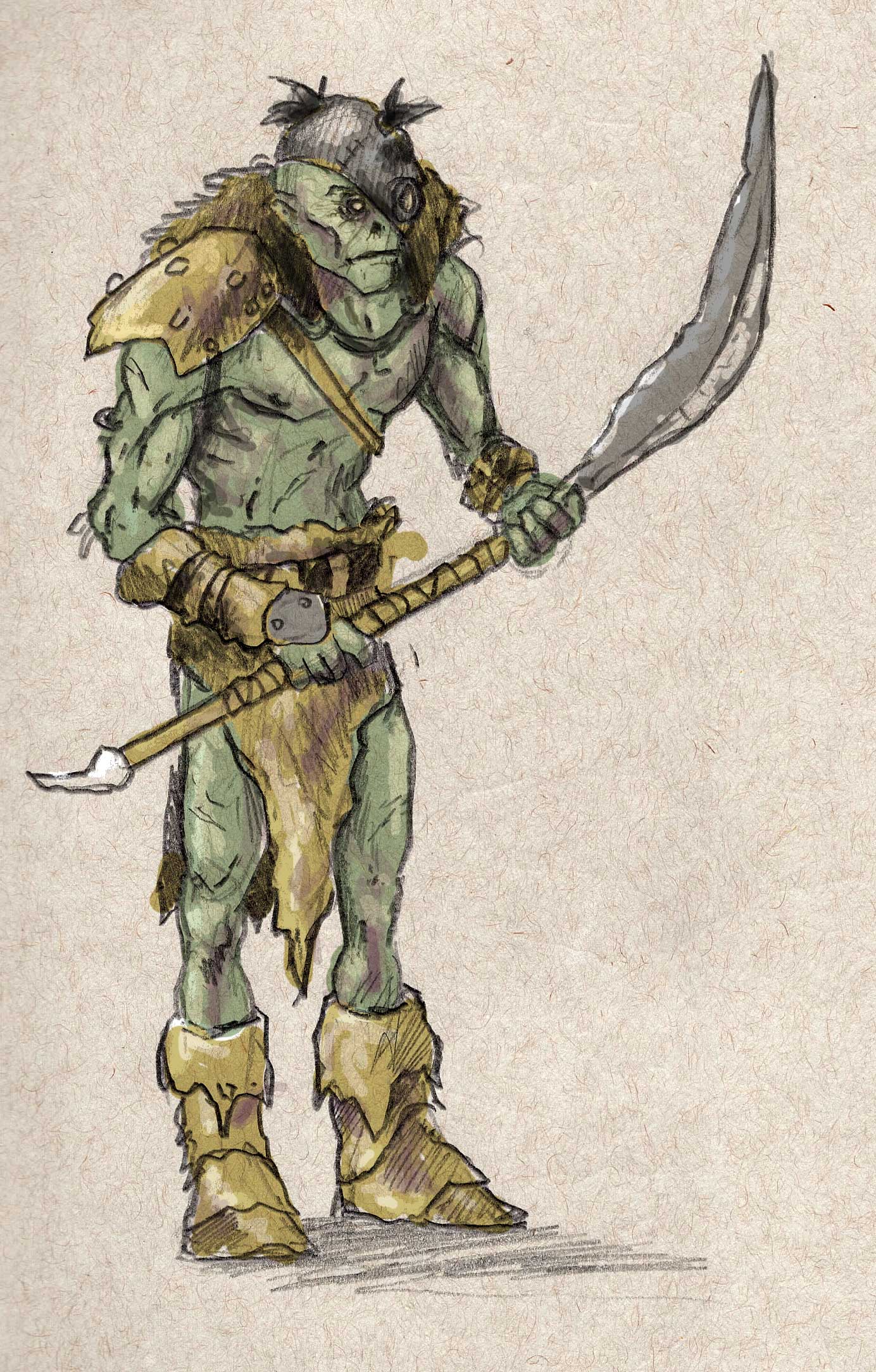
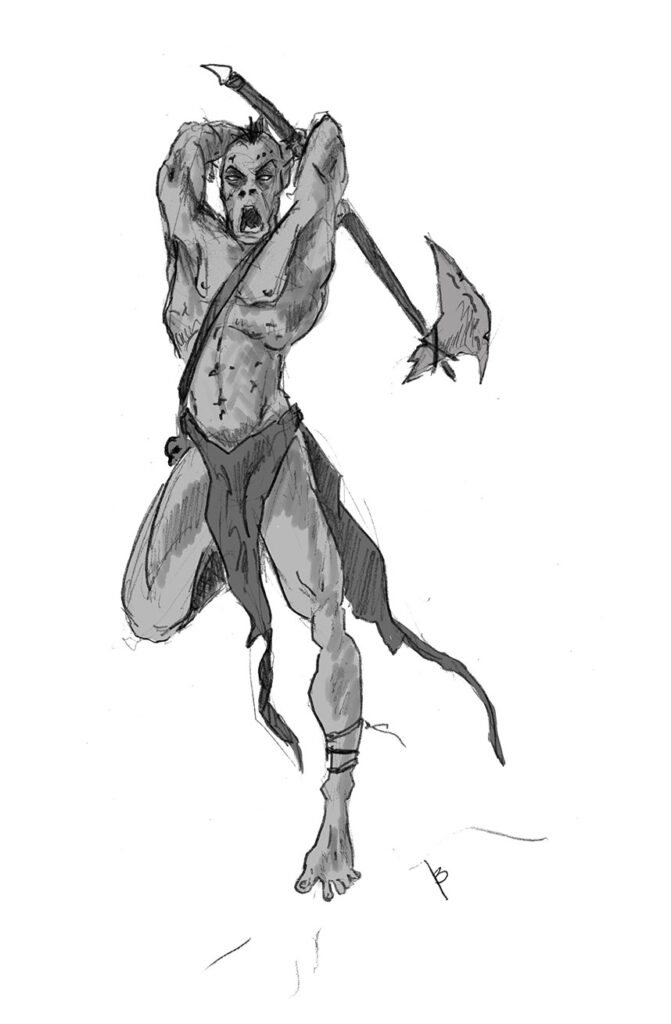
Savage is the only word needed to describe the ghul. Supposedly, these creatures are the twisted remains of Eastlanders who were caught in the dark magics of the Aradan War. They are now the most widely spread menace to civilization. Raiders, bandits, cannibals—there is no limit to their depravity and madness.
The origins of the ghul cannot be stated with certainty, but they appear to be the descendants of those who were twisted and deranged by the dark magic of the 30-year war between Aradan and Pardalor. Whatever the truth, they have become a twisted, evil, and outcast people. Dworvs call them “ghuls,” which in their tongue is related to the word “lost.”
The ghul hate all other living things and show a strong dislike between their own tribes. They are hunter-gatherer societies—more like packs—who take advantage of any easy prey, from animals to farmers. They are raiders, feared in any land through which they roam. Luckily, due to their exceedingly chaotic and violent nature, their population has typically remained sparse in the 700 years since they were first encountered.
They are most common in the East, though lately some have been seen as far west as Garaden. In recent years, rumors have begun to spread that someone has organized them for some sinister purpose. With all the strife now in the North, we can only hope that this is just a rumor.
One common trait they seem to share is a reverence for honorific body scarification and disfigurement. This may be due to the deformities that many suffer from long exposure to the toxins in the Eastern plains.
Little else is known of the ghul, as their beliefs, languages, and rituals differ widely from tribe to tribe.
—Etahn
Etahn and I encountered a band of ghul on our first research excursion. We had no choice but to destroy them, as consumed by hatred for our kind and unrelenting in their aggression as they were.
But what can one expect of a people of such tragic history? Many historians believe—and the evidence is quite convincing—that the ghul are direct descendants of those who fought for the Warlock King, used by his necromancers as disposable fodder for the front line of that bloody war. They did not choose to become what they did—who would?
The ghul appear mostly teran, though they often look emaciated and pale; some can grow larger than teran and more muscular. They scar, disfigure, and tattoo themselves. It is because of their appearance that many do not believe that they are descended from terans.
Special Qualities: Low-Light Vision; Natural Resistance:+2 Save vs Poison and Disease
Ecology
Environment: Any
Organization: Single, Pair, Tribe (2-10)
Treasure: Standard
Ghul Shaman
Ghul tribes are often led by a single shaman. These shaman understand the visions of both worlds and lead their people, hoping to find their way in a world that rejected them.
A wylder can use Spell Sight to memorize a spell that they witness being cast. This ability is detailed further in the chapter on Magic.
Spell Memory
Unable to record spells in a spellbook, wylders are limited to a number of spells they can know at a given time. This is based on class, level, and ability score. A wylder can commit a number of spells to memory equal to their Spell Memory Allotment for a given spell level plus their primary ability score modifier.
A burst of energy explodes from the wylder’s hands towards a target. On a successful ranged touch attack with a +2 to the roll (figured in above), the wylder inflicts 1d4+1 damage as a force effect. Range 60’.
Focus and Ravage
An unman shaman can do focusing and ravaging to cast more spells as described in the Sagaborn Core Rulebook.
Gilandras was a hero of the elves. Most elf cultures claim them as one of their own, but no one knows his cultural origins.
Gilandras was the greatest among the hunters of the elves. He had defeated the great
dragon when it had threatened the elves, and he was known far and wide among the elven races and the animals. He would spend years roaming the forest of the world (elves live for close to 2000 years at this point in history ). one night, under the starlight he hears a beautiful voice flowing among the trees and in a starlit field he see the most beautiful elf.
He begins to sing with her and when she becomes aware of him she leaves. He hunts after her but he can find no tracks. after a year of searching he once again hers the singing and follows to a small waterfall where she sings and dances along the rivers edge. When he joins her in song, this time she does not run, but instead welcomes him to the dance. They spend many months together singing and dancing, telling stories under the stars, but she always leaves him in the morning to rejoin him again at night. after a while, Gilandras offers her his love. at this, she begins to cry. he does not understand, why she is saddened by this, but she turns and he sees the truth in her eyes. she is not an elf, but in actuality Lunare, the goddess of nature. even though he is long lived, he is still mortal and she a diety so she can not love him back in the same way. so he picks up his bow and marches off to the west, following the bright red star that fills the west in autumn. he never returned and the elves now call that star (actually it is a planet, but thats another story) the star of lost love. and in the western sky, when the star of lost love begins to move up in the sky, three stars rise up from the western horizon that are the bow of the hunter, forever chasing after his unattainable love.
Talents: 2 points or recommended: Alertness, Stealthy
Special Qualities: –
Ecology
Environment: Any underground
Organization: Solitary, or pair
Treasure: Incidental
Filament
A glimmer worm drapes its lair with silk-like filaments. The strands are thin and transparent, needing a DC 20 perception check to see them. A creature who accidentally touches a glimmer worm’s filament becomes attached to the sticky thread. As a standard action, a creature can rip the filament free with a DC 20 Strength check. A caught creature can also attempt to escape a filament by making a DC 20 Acrobatics check. A filament has 10 hit points, and has DR 15/slashing. An application of liquid with high alcohol content (or a dose of universal solvent) dissolves the adhesive and releases the creature caught by the filament. A glimmer worm can have up to twelve filaments at a time.
Pull
Once a target is stuck in a filament, the glimmer worm reels the target into its maw. It must succeed at a Heroic Action (STR vs STR) to pull the target at 30’ per round towards its mouth. A glimmer worm has a +4 racial bonus on Heroic Actions made using its Pull special attack. The Glimmer Worm gets a single bite attack the same round if it successfully pulls the target to its mouth.
Hold
A target that is successfully pulled to the Glimmer Worm loses its DEX bonus to AC. Each round while held, a trapped adventurer may attempt a Heroic Action (STR vs STR) on their turn to try and free themselves.
Talents: One point or recommended: Over-Extended Attack
Special Qualities: Darkvision 60ft
Ecology
Environment: Warm Plains
Organization: Solitary, pair, hunting party (2-5 and 1-2 hyenas), band (10-100 plus 50% noncombatants plus 1 3rd-level sergeant per 20 adults and 1 leader of 4th-6th level and 5-8 hyenas), or tribe (20-200 plus 1 3rd-level sergeant per 20 adults, 1 or 2 lieutenants of 4th or 5th level, 1 leader of 6th-8th level, and 7-12 hyenas; underground lairs also have 1-3 trolls)
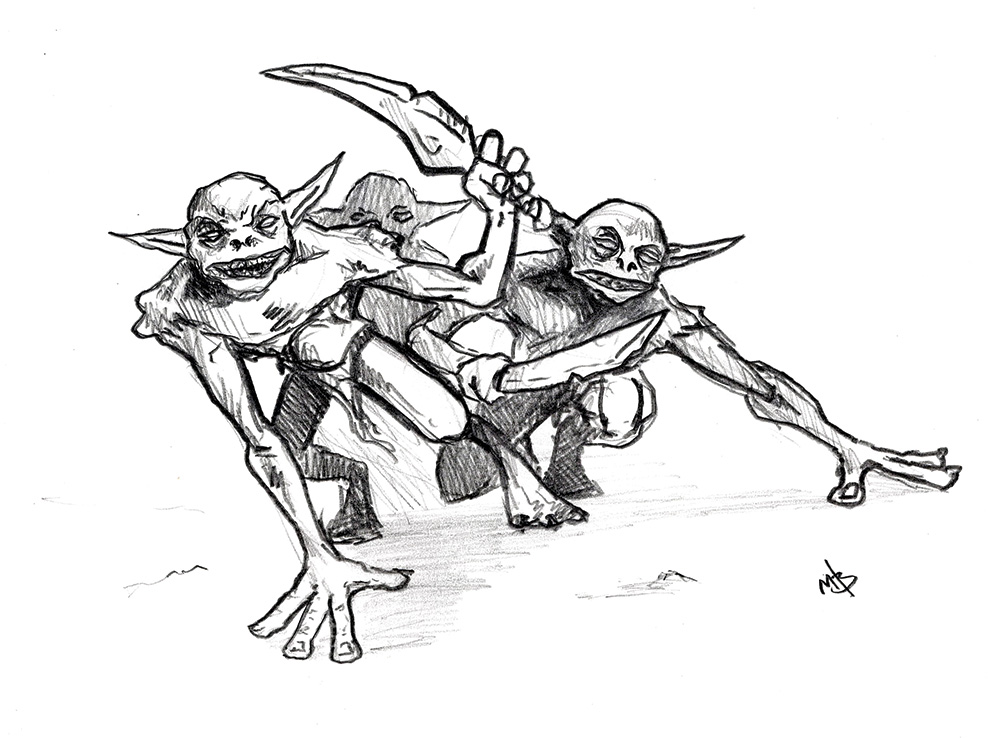
A small two creature looks at you through marble like eyes. It’s skin is an unhealthy pale color of something that sees little sun, and its hair and nails are yellow. Its leather armor smells of dead animals and it raises a wickedly notched blade menacingly.
Goblin
Challenge Rating: 1/3
Size: Small
Type: Goblinoid
Initiative: +1
Defense
Hit Points: 5 hp (1d8+1)
Armor Class: 15 (+1 size, +1 DEX, +2 leather armor, +1 shield
Saves: Fort +3 Ref +1 Will -1
Offense
Speed: 30’
Base Attack: +1
Melee: Mace +1 (1d6)
Ranged: Spear +2 (1d6)
Special Attacks: –
Statistics Abilities: STR 11, DEX 13, CON 12, INT 10, WIS 8, CHA 6 Skills: +1 Acrobatics, Athletics, +3 Awareness, Endurance, Knowledge, Persuasion, Spellcraft, Survival, +2 Thievery Talents: Alertness
Special Qualities: Darkvision 60’
Ecology
Environment: Any
Organization: Single, Gang 4-9, band 10-100
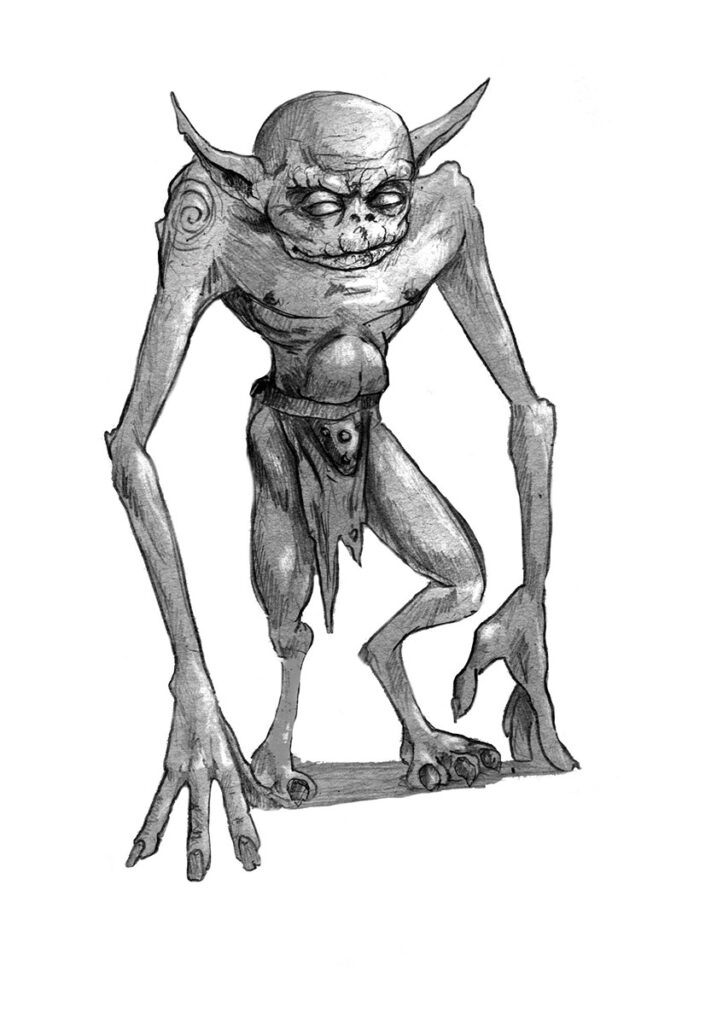
Arnach goblins stand about three-and-a-half feet tall, and are spindly and skeletal in appearance. Despite this, they are actually quite strong, capable of climbing along the large trees of the forest with alarming agility and speed. Their large eyes allow them excellent site in the dark woods, and their thin, cruel mouths are filled with sharp, translucent teeth.
Resembling the spiders they love to raise, the arnach goblins share many of the same traits as their more common goblin cousins.
Organization: Solitary, pair, hunting party, or clan (3–12)
Treasure: Standard
Special Abilities
Expert Climber
An arnach goblin can climb and swing through the treetops with a skill that borders on the impossible. In effect, an arnach goblin is treated as if it is under a perpetual non-magical version of spider climb in regards to vegetation, rock walls, or cliff faces. This ability gives a +4 bonus to Acrobatics and Athletics checks dealing with any climb-related skill checks.
Poison Use
Arnach goblins are skilled in the use of poison and never risk accidentally poisoning themselves. They favor the poison of the death’s eye spider. This poison can be applied to both the arrows and swords of the goblins.
Death’s Eye Spider Poison—injury; save Fort DC 12; frequency 1/round for 2 rounds; effect 1 STR damage, cure 1 save.
Spider Sac Arrows
Goblins can use special arrows that replace the standard arrowhead with a large spider sac. Upon a successful ranged attack, these arrows deal 1 point of damage and unleash a swarm of spiderlings upon the target. Brushing off the spiders requires a standard action to completely remove the spiderlings and sac. Doing so disperses the swarm.
If a character attempts to perform an action prior to wiping off the spiders, the following penalties are suffered: spellcasting or concentrating on spells while covered in spiders require a Spellcraft check (DC 12 + mana cost). Using a skill that involves patience and concentration, or attempting an attack, requires a DC 12 Will save. The spider swarm deals an automatic 1 point of damage to any creature whose space it occupies at the end of their move, with no attack roll needed.
A diminutive creature, these small beings are as plentiful as humans, but tend to keep their numbers in check by infighting among tribes. They are descendants from the true fey, but they have lost their fey magic, instead being creatures of petty jealousy and violence.